
A Personal Note on Research and Practice
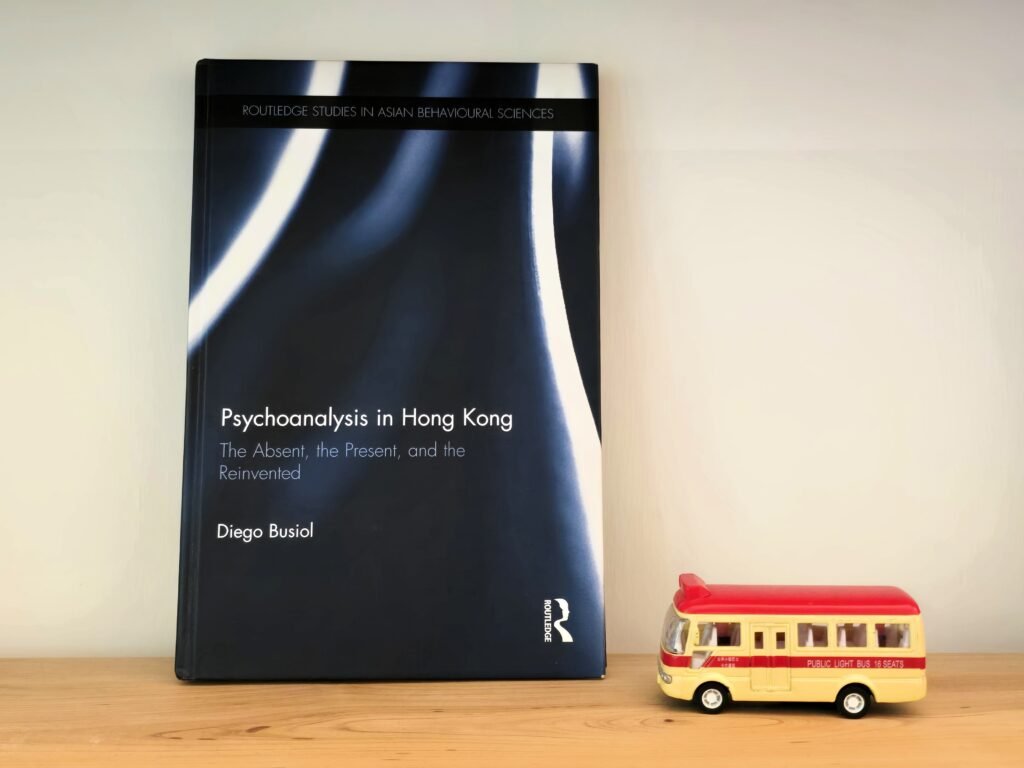
Some years ago, I published a book that emerged from my PhD research and my first years of living and working in this city: Psychoanalysis in Hong Kong: The Absent, the Present, and the Reinvented (Routledge, 2017).
I wrote it at a time when I was still trying to make sense of a puzzling discovery: that something which had shaped almost every corner of intellectual and clinical life in Europe—psychoanalysis—was almost completely absent here.
This article is a brief introduction to that book, to the questions that gave rise to it, and to how those questions continue to shape my clinical practice today.
From Italy to Mong Kok
My formation took place in Europe, mainly in Italy, where psychoanalysis lives far beyond the consulting room. There, it is part of the air: it permeates philosophy, literature, cinema, and political theory, shaping everyday ways of speaking about desire, conflict, and subjectivity.
When I moved to Hong Kong in 2010, I chose to live in Mong Kok—one of the most densely populated areas in the world, intensely local and almost entirely Chinese. Restless streets, neon signs, wet markets, Cantonese everywhere. It was a deliberate choice: I didn’t want a European bubble; I wanted to be affected by this city from the inside.
Very quickly, I noticed something striking. When I said, “I’m a psychoanalyst,” most people simply did not know what that meant. The name Freud rang no bells. Even the word “unconscious” had little resonance. The only term that created a faint connection was “counselling,” and even that was usually understood as brief, pragmatic advice-giving.
Coming from a world where psychoanalysis is sometimes taken for granted—or even attacked—this silence was puzzling. It raised questions that followed me everywhere and became the backbone of the book:
- Why did psychoanalysis never root itself here?
- Was Hong Kong indifferent to it?
- Or was something psychoanalytic already happening, quietly, under other names?
Shifting the Question: Beyond the “Export Model”
Much Western writing about psychoanalysis in Asia begins with an assumption: that psychoanalysis must be “brought” or “adapted” to Chinese societies. But once in Hong Kong, I found myself at a methodological dead end. I could not research psychoanalysis the usual way because there was almost none to research.
I realized that simply asking local therapists, “Do you use psychoanalysis?” or inquiring about their knowledge of, say, the Oedipus complex would not lead far. Furthermore, a clinician can claim to be “psychoanalytic” by repeating the right jargon without actually listening in a psychoanalytic way; conversely, another person might never use a single psychoanalytic term yet adopt a position that is structurally very close to analysis.
So, I chose a different entry point. I tried to describe psychoanalysis not through its theories, but through its practice. We usually call psychoanalysis a talking cure, which it is. In writing this book, I came to see it, even more fundamentally, as a listening cure.
The Three Pillars of Listening
To understand whether something like psychoanalysis existed underground in Hong Kong, I had to define what distinguishes analytic listening from any other form. I identified three dimensions:
- The Unconscious: The conviction that what we say always exceeds what we intend. Slips, contradictions, repetitions, dreams, and symptoms are not accidents; they are formations of an unconscious that has its own logic.
- Transference: The way old relational patterns and expectations reappear in the relationship with the analyst—not as a nuisance to be eliminated, but as the very material of the work.
- Free-Floating Attention: A listening that does not hunt for a specific piece of information or chase a preconceived goal. The analyst does not try to understand “everything” or collect data; instead, they allow unexpected connections to emerge.
I then designed a study involving 217 helping professionals in Hong Kong—social workers, counsellors, and psychologists—most of whom identified with Cognitive Behavioural Therapy (CBT) or brief therapy, or some humanistic approach and had never undergone personal analysis.
I constructed a questionnaire that measured 3 psychoanalytic dimensions (Unconscious, Transference, and Free-floating attention) versus 3 counselling dimensions (Directivity of the cure, Restoration, and Focused Attention—i.e., a more goal-oriented, symptom-relief approach). This was not just a technical, methodological exercise. It was primarily an attempt to redefine psychoanalysis beyond its internal schools and orthodoxies.
The results were revealing. While psychoanalysis as an explicit orientation was almost absent, many practitioners listened in a way that partly overlapped with it. They scored relatively high on dimensions such as letting clients speak freely and being attentive to their own emotional reactions. A certain receptivity was there. Listening could be warm, relational—but not yet oriented toward what speaks “behind” the discourse.
However, the weak point was the unconscious. When it came to questions about dreams or unconscious fantasies, the connection dropped. The listening was relational and accepting, but not explicitly oriented toward less surface meaning.
The Chinese “Combinatorial” vs. The Western “Either–Or”
This research led me to a deeper reflection on how Hong Kong Chinese modes of thinking shape clinical practice.
The book argues that what Westerners often label “eclecticism” in Hong Kong Chinese clinicians—the tendency to mix CBT, humanistic, and systemic ideas without concern for theoretical incompatibilities—is not simply a lack of rigour. It reflects a deeper “combinatorial” logic.
Chinese traditions (Confucian, Daoist, Buddhist) are comfortable with “both–and,” holding together elements that Western, Aristotelian thought wants to keep apart. They prioritize harmony, balance, and relationship over internal theoretical purity.
Psychoanalysis, born in the European crisis of the subject and nurtured by traditions of logical debate and systematic doubt, thrives on contradiction, conflict, and rupture. Here, the individual, the interior life, and the act of speaking about oneself were central. Hong Kong offers a very different framework: one that values pragmatism, restraint, relational harmony, and silence as a way to defuse conflict and preserve discretion.
This partially helps explain why the Freudian unconscious was not “discovered” in Chinese-speaking contexts. It is not that Chinese culture lacks depth, but that it organized that complexity along different lines. In such a context, many assumptions that psychoanalysis takes for granted—free association, introspection, the idea of an unconscious that speaks through language—do not automatically translate. The self has traditionally been understood as relational and positional rather than as a sovereign interiority that must “know itself.” In such a world, the Freudian gesture—“the ego is not master in its own house”—does not land with the same explosive force.
Psychoanalysis Without Ideology
One of the most important lessons of my years in Hong Kong is this: when psychoanalysis lets go of the weight of its own ideology, it becomes lighter. It becomes more agile, more attentive, and more capable of listening.
Too often, psychoanalysis is imagined as a Theory—a pre-existing truth to which practice must conform. In that shift, theory ceases to be a compass and becomes a doctrine. And doctrines, as we know, inevitably generate churches. Each school begins to guard its orthodoxy, its terminology, its way of saying the same thing.
Hong Kong forced me out of that comfort. It taught me that theory cannot precede the encounter. Theory and practice are not two separate levels, but one informs the other, reciprocally and continuously.
To work in a different cultural world means accepting that one’s own conceptual scaffolding may tremble. And that this trembling is not a threat, but a condition of truth. Because if theory simply anticipates the encounter, then listening becomes impossible. One ends up hearing only what one already knows.
What Remains: The Listening Cure
Working on this research, and simply staying in Hong Kong, has profoundly changed my own way of working.
Hong Kong—with its compressed living spaces and conservative hierarchies—refracts classic neuroses through a uniquely modern, high-pressure lens, distinct from both its Victorian origins and the liberal West. Yet, the suffering revolves around familiar questions: desire, identity, ambivalence, conflict. Psychoanalysis can address them, but only if it preserves its essence while allowing its form to be reshaped by the encounter, rather than imposing a shape upon it.
Particularly in a context where long, introspective speech is culturally unusual and sometimes mistrusted, it becomes clear that psychoanalysis is not defined by the material rigidity of the setting—such as the frequency of sessions—but by how we listen to whatever is said, or left unsaid.
Being at the margins of the psychoanalytic world forces you to ask: what is truly non-negotiable in practice? For me, it comes down to:
- Maintaining a focus on the unconscious, always;
- Prioritising what is said (and how it is said) over the application of predefined techniques;
- Privileging questions over answers.
Psychoanalysis in Hong Kong does not offer a settled answer. It is the record of a process of being displaced, and of trying to let that displacement become productive.
If there is one conviction that has only grown stronger for me since the book’s publication, it is this:
Psychoanalysis will not be “saved” by proving its scientific effectiveness or defending its past. It will survive—and perhaps reinvent itself—only if it allows itself to be questioned, unsettled, and re-thought from places like Hong Kong, where it has never fully taken root.
Find the Book
If you are interested in exploring these themes further, Psychoanalysis in Hong Kong: The Absent, the Present, and the Reinvented is available on Amazon in both Kindle and print formats.
If you decide to pick up a copy—or if you have already read it—I would be very grateful for an honest review. It helps keep this conversation visible and alive.